At ELAN, we’ve been labelling warehouses for nearly 30 years. During that time, we’ve worked on many projects involving the use of floor labels. Although floor labels are an excellent way to efficiently label a warehouse, they aren’t suitable in all cases.
Let’s look into the reasons why, and how Elan’s advice can help to achieve better results.
A label’s resistance vs its environment
To understand where issues can sometimes arise, we have to look no further than the laws of physics. Don’t worry, we’re not going to get into a physics lesson!
However, we have found that labels can sometimes cause problems when they are used incorrectly, such as in environments that will accelerate their wear and tear. Should a customer install floor labels in places where forklift trucks, roll cages or even pallet trucks will go over them, this will put a tremendous amount of pressure on those floor labels.
To illustrate this, here’s an example:

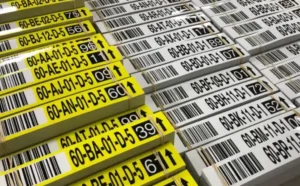
This label consists of a self-adhesive polyester encapsulated material.
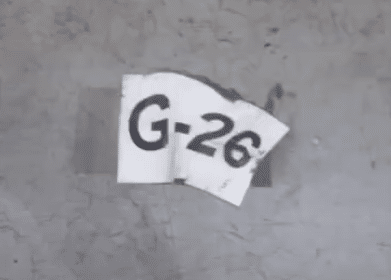
Even though we use incredibly strong adhesives to stick our labels down, if forklifts or cages roll over this type of label repeatedly, neither the adhesive nor the top material will be able to sustain it. The label will either get ripped in half, or get ripped off the floor, as per the below picture:
Different floor label solutions and their challenges
A sturdier floor label option are anodised aluminium labels. Although they incur a step-up in cost, they are very durable. The barcode is embedded into the surface through an anodising process. Then, the label can either be screwed into the floor itself, or it can sit in an aluminium surround, or alternatively it can sit embedded in a plastic disc sunken into the floor.

Although they’re a very good label option, aluminium floor labels also present some challenges. Firstly, aluminium is a soft metal; secondly, the labels themselves have an exposed edge. Should the label protrude out even slightly, this will make it more likely to be hit by the edge of a pallet, a forklift truck, or even floor debris such as nails. If this happens, the label will be damaged or destroyed.
In order to remove that problem, we at ELAN but also other companies have tried sinking labels into the floor. A great idea in theory, but in reality, although the barcodes are anodised into the surface of the label, should the label be exposed to forklift truck wheels over and over, the print will eventually rub off. This is made worse by the fact that forklift truck wheels are usually very dirty, which in effect acts like sandpaper.
Another challenge with any type of floor-embedded label is that while adhering to the back of aluminium is straightforward, and bonding to concrete is relatively simple, achieving a secure attachment to both surfaces simultaneously is nearly impossible. This leads to having to rely on mechanical fixings which also have their limitations: they can become dislodged if placed under the pressure of a forklift truck repeatedly. This causes an even bigger problem: having to call out a contractor for repairs.
Are floor labels right for your warehouse?
Floor labels can be used very successfully. For example, ELAN have worked with The Co-Op to provide floor labels for their roll cages areas, which have worked very well. However, in our experience, it isn’t advisable to place floor labels in the path of a forklift truck or other Materials Handling Equipment, as this puts too much pressure on the labels. As a general guideline, if a label is going to be rolled over multiple times, this could create significant problems: any form of expectation of running over it will lead to a poor result. Placed strategically, on the other hand, they can be efficient and achieve good results.
Consider upgrading to hanging signs
We believe that a reliable, long-term solution can be achieved by utilising a ceiling-mounted approach to labelling the area. Although there is a cost involved and it may not be your preferred direction, hanging signs offer a great opportunity to implement a solution that requires minimal maintenance after installation and reduces the risk of the labels getting damaged.

So there you have it: although floor labels are an excellent warehouse labelling solution, you need to consider the environment you’ll be using them in and how much strain you’ll put on them.
Too much heavy machinery passage over the labels will accelerate their wear and tear, whereas clever positioning in suitable areas will ensure your labels work well, and help your warehouse operations run smoothly.
If you don’t think floor labels are right for your warehouse, then ELAN Europe offers plenty of other options, such as hanging signs.
To learn more about ELAN’s expertise in warehouse labelling, make sure to explore our Knowledge Hub.