Knowledge Hub
Get access to all of our videos, FAQs and downloads in one place.
Warehouse Labelling
Playlist
7:50
4:01
6:01
1:46
1:27
0:42
6:26
5:14

1:20

1:53

1:38
Labelling FAQs
Yes, we handle the entire label production process in-house. We use our custom design software to ensure high barcode quality and clarity, which is essential for accurate scanning. Our setup includes two high-quality Fusion Laser Printers, two laminators, one encapsulator, and two guillotines. With this equipment and our skilled team, we’re able to maintain full control over quality and production speed. Plus, having duplicates of most equipment means we can avoid any delays in lead times if there are technical issues.
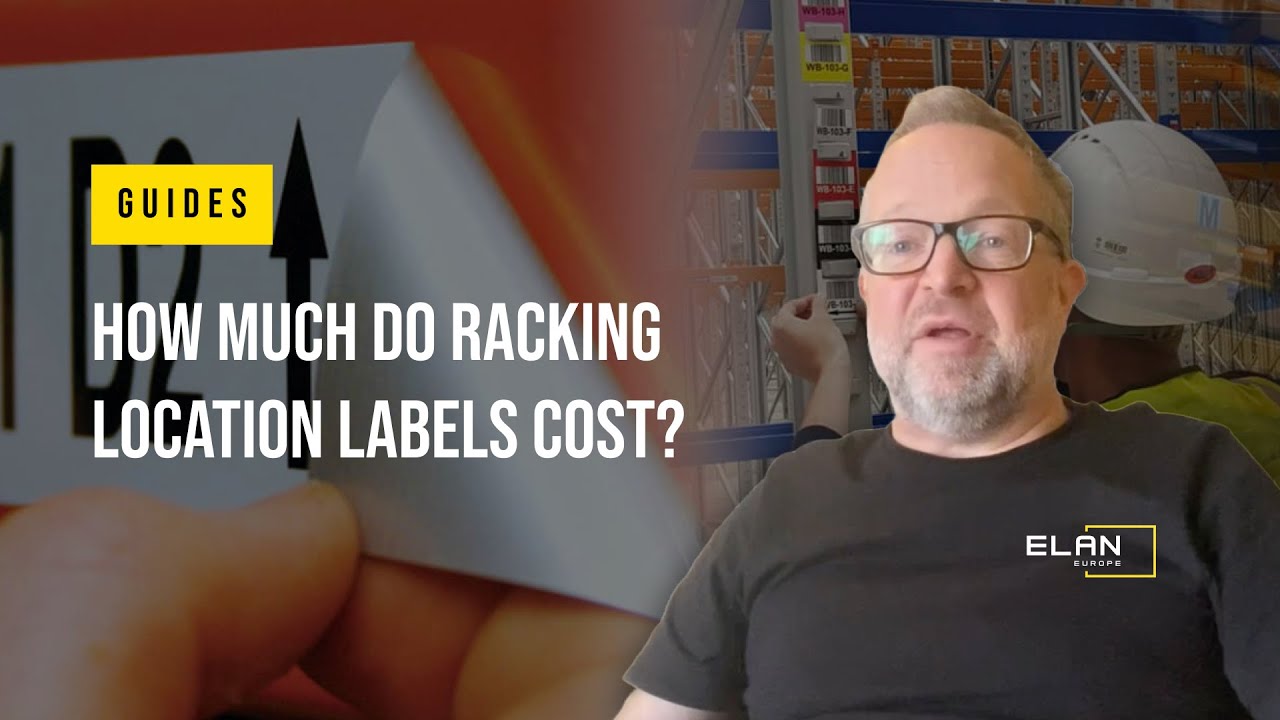
At ELAN, we sell racking location labels by the number of completed SRA3 sheets, which are then cut into labels. While you might think in terms of labels, we work with and price in sheets.
The material we use is synthetic, such as polyester, with a laser coating for durable printing. The cost of this material is around £0.60 per sheet (equivalent to £4.50 per square metre of material. Price as of Autumn 2023). Printing costs are also factored in. For laser printing, this is about 1p per sheet for black and white or 5p for colour. Lamination, if required for extra durability, adds approximately £0.10 per sheet. So in terms of materials only, a sheet of printed material costs around £0.65 per sheet, or around £0.75 if the sheet is laminated.
Production time is another consideration. This includes printing, laminating (if needed), cutting, and ensuring the labels are in the correct order. Additionally, pre-sales coordination, proofing, and communication are necessary to ensure the job is accurate and meets your needs.
The final cost per sheet also accounts for a proportion of the cost of the equipment (e.g., £45,000 laser printers) and business overheads, such as building and insurance costs.
With all of these elements taken into consideration, we end up charging between £3.20 and £11 per sheet for racking location labels, depending on the volume ordered. But how does that price per sheet then equate to a price per label?
Well, if you’re looking for shelving labels, the price starts at around £2 per label for smaller orders (e.g., 50 labels) and decreases to approximately £0.12 per label for very high volumes (e.g., 100,000 labels). For racking labels, costs range from around £2 per label for small orders (e.g., 50 labels) to as low as £0.34 per label for larger orders (e.g., 30,000–50,000 labels).
We hope this gives you an insight into the factors that come into the cost of racking location labels and how these translate into the final price for our customers. If you have any questions or need further clarification, please don’t hesitate to contact us.
Yes, we can install location labels on external racking, but there are a few things to keep in mind:
Galvanised Steel: If your racking is galvanised, ensure it’s properly degreased, as an oily residue from the galvanising process can affect the adhesive and lead to the label not adhering properly.
UV Exposure: Labels exposed to sunlight may fade over time, especially in colours like red, orange, and yellow. Black tends to hold up better. To prevent fading, we recommend laminating outdoor labels.
Surface Texture: A smooth steel surface is ideal for label adhesion. If the beam has a matte or rough finish, there is a smaller degree of surface contact with the adhesive, which can cause problems. In these cases, we can provide labels with a thicker adhesive layer for better adhesion.
With these three considerations in place, installing location labels on outdoor racking is generally not a problem.
Amazingly this question doesn’t come up any more. 25 years ago when location labels were either black on white or black on yellow and printed through non colour digital printers such as thermal printers we did get asked this question quite a lot but as the vast majority of location labels are now printed in colour they have become main stream.
The answer is to the question is the price difference between colour and mono location labels is about 3%.
- Unlaminated self adhesive is 430 mm x 310 mm
- Laminated self adhesive 410 mm x 300 mm
- Laminated Magnetic 410 mm x 300 mm
- Teslin Encapsulated standard or ultra hight strength adhesive 400 mm x 280 mm
- Card insert labels 430 mm x 300 mm
- Thermal transfer (black on white labels) 900 mm long by 150 mm wide.
As a laser printing company we are limited to laser printer capacity which in our case is SRA3 size at 450 mm x 320 mm. By the time we have trimmed the edges to make a finished label we are able to produce the sizes above.
We do have a thermal transfer printer that we use predominantly for long range reflective labelling but this prints up to about 900 mm and has a maximum print width of about 150 mm.
This depends on what we are installing the labels onto, where they are and how far apart they are.
On pallet racking 2 main things play a part in installation times. If we can get a scissor lift into the aisle that enables us to install both sides of the aisle at the same time. This can literally halve the time a racking label installation can take. So in a narrow aisle situation where the beams are typically 2m apart, 2 or 3 labels per beam and several beams in a bay we can install about 2000 labels per day for a team of 2.
When the aisle is wide at say 3m this drops to between 1000 and 1200.
Other items that slow installation down are labelling over existing labels or of the racking is already loaded with pallets. These 2 items usually enable some element of damaged label mitigation and restrict the use of measuring sticks and if a pallet is already on the beam this limits installing the label very quickly as it gets in the way and adds a splinter risk to the installer who subconsciously slows down so as not to get hurt.
On long span shelving accessed from ground level the installation rate on new beams increases to approx. 2500-3300 labels per day depending on the spacing between the beam and the labels on those beams. Obviously the further apart everything is the longer it takes to cover that time. This might not seem a significant consideration but saving 1 second 10’s of thousands of times really does add up.
In small parts shelving where labels and shelves are very close together installation rates are at there quickest. Up to 4000 labels per day for an experienced team of 2.
Labels installed onto a concrete floor might take some time as we usually have to lay lines of floor tape and measure out an area before we install them. Also with floor labels we may need to clean the concrete first. Somewhere between 100 and 400 per day. Without understanding what is required estimating floor labels is quite tricky.
Aisle markers. A single person working from a lift using TEK screws and a power drill can install up to100 aisle markers per day.
Yes, we are more than happy to help make sure you have the correct labels in your operation. We normally like to do this at quote stage so we have a QMS process to follow. This makes life easier for both you and us later on if you come to place the order with us.
Information we need to know is as follows:-
What is the location reference sequence and are they numbers of letters? i.e. aisle bay level / A-01-A
Do you need an arrow to demark if the location is above or below the label?
Do you need a check digit and if so how many numbers and/or letters is it? e.g. 99 or AA or A1A1A1
Do you need a barcode? If so what does it need to read, The location only, location and check digit or just the check digit? Does it have special characters in it like the dashes or any prefixes?
And finally colours? Do you want any colour separations to help with identifying levels or specific shelves?
If you are looking for a complete set of label proofs with location files to check them off against we can do that without you raising an order but we would like an email of intent.
If your motivation behind this is to either make sure you don’t incur a cost before you know exactly what you are going to receive or because you are not sure exactly how many labels you need and changing the PO is difficult once it has been raised we can support these items with you.
We commit not to charge you until we have incurred a material cost, i.e. printed, manufactured or committed to an external supplier, so us working on your proof and location files isn’t chargeable, unless doing a proof or making a location file has been quoted as a specific item due to complexity or this is the only item you need completing.
We understand that administration and procedures at your end can add time and inconvenience to you and we want eliminate or at least minimise that for you.
If you need to raise the order after the job is proofed please just send us an email asking us to proceed to the proofing stage without committing to any costs and we will make the location files and design proofs for you. We can then confirm costs and you can raise the order prior to us commencing any printing and incurring costs on your behalf.
Yes we do provide an installation service but we don’t employ our own installers. We use training subcontractors.
We manage installation quality and progress through our operations team who are employed.
We do take full responsibility for the quality of the installation through the project.
If you want to install the labels yourself we have a guide that is free and available on YouTube.
Laminated labels are not necessarily better or worse than non-laminated ones. I believe for most people it is a matter of considered choice for most customers and here is why.
I have laminated millions of labels over 30 years and never had a single comment about lamination causing an issue with location label scanning.
Scan range issues or poor scanning performance is always down to poor quality print, the x dimension of the barcode is too small or the scanner isn’t set up correctly or have an inappropriate scan engine it it.
If a supplier is telling you lamination and bright lighting can detrimentally affect location label scanning this is incorrect. It simply affects their profit margins as they have to do 3 more processes to make the label. I have never seen a warehouse with very high lighting levels and please see our youtube video on scanning laminated location labels.
So to make a considered choice lets first of all let’s examine why there may be a need to laminate.
All laser printing materials have a toner receptive surface which makes them slightly matt in appearance. In order to get the laser toner to stick to the surface of the synthetic paper it needs a slightly rough surface before it is passed through the fuser within the printer.
Subsequently, if the label is not laminated after the print process and goes to site and is installed and is subsequently wiped over with dust on the surface this dust gets engrained in the label.
In addition, with the exception of anodised labels, all printed barcodes sit of the surface of the material and not within the surface of the material so lamination protects the print surface from minor scrapes.
Now I am not going to sit here and tell you that a laminated label is going to survive an impact with a fork lift truck, it isn’t so you need to consider if the labels you are using may get slightly knocked or scarped.
Back to choice again.
With rack labelling there is no detriment to having a label laminated.
Some sectors may specifically benefitted from laminating. i.e. operations that store liquids, or have any amount of dust build up, slightly more industrial say some fabrication works near by, etc.
If you feel you need it please go ahead and specify it.
The price difference is about 20-25% and sometimes just comes down to the values of the company and where you sit on quality or investment. Personally I would laminate labels but its your choice but please make it a considered one.
Our SilverBack™ labels were inspired by innovation in the paint tin industry. Originally, paint manufacturers developed a method to create consistent colour labels for their paint tins by applying a silver backing. This ensured no background colour interfered with the label’s appearance, providing an accurate representation of the paint colour. We’ve adapted this idea for the warehouse environment, where scanning precision is critical.
Get even more detail!

ELAN Europe Proudly Supports Women in Logistics UK
At ELAN Europe, we believe that meaningful progress starts with people. As specialists in warehouse labelling, warehouse labels, and warehouse netting solutions, we understand how
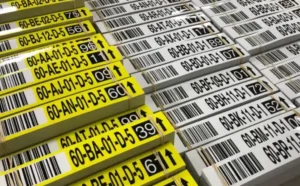
What should go on a location label?
Location labels are far more than just stickers in a warehouse – they are the backbone of navigation, accuracy, and efficiency. But what exactly should

ELAN Enhances Warehouse Safety and Identification Systems for Great Bear
When Great Bear needed a trusted partner for their Sheffield depot, they turned to ELAN. Here’s how we helped them get their new site up and running.
Warehouse Netting
Playlist
0:59
0:28
1:19
0:44
0:39
0:46
0:27

0:28

0:58

0:37
0:23
Netting FAQs
There are different kinds of warehouse netting, each with a specific use. Back-of-rack netting stops items from falling off the back of storage racks. Handrail netting is used on raised walkways to prevent objects from dropping onto people below. Debris netting is for catching smaller items or loose bits that might fall, which is handy in construction or repair areas. Each type of netting helps protect workers, equipment, and stock in different situations.
Our warehouse netting is made from a high-tensile material called polypropylene. This material is chosen for its strength, durability, and ability to withstand the demanding conditions of industrial environments. Polypropylene offers resistance to chemicals, moisture, and abrasion, making it suitable for a wide range of applications. This ensures that the netting can effectively contain falling objects and provide long-lasting safety solutions.
Yes, warehouse netting can be customised to fit different safety needs and spaces.
You can choose the size of the netting to fit various shelf sizes, and select the colour to match safety rules or make it easier to see. Other options include different ways to attach the netting, like using carabiner clips or cable ties, and adding reinforced edges for extra strength.
This means the netting can be made to suit the specific needs of each warehouse.
At Elan, we carry blue and black warehouse netting. These are commonly used because they are easy to see and look neat. But there are other colour options like red, yellow, green, and white.
Different colours can be used for different purposes, like using red or yellow to show dangerous areas or to alert workers, while green or white might show safe areas or spots needing special attention. Using different colours helps make the workplace safer, easier to see, and more organised.
There are a few ways to install warehouse netting, depending on where it is used and what it is needed for.
You can use carabiner clips for easy and quick attachment and removal or cable ties for a more permanent fix.
Brackets can also be used to secure the netting to racks or walls, making it more stable.
The method you choose depends on what you need the netting to do and where it is placed. Correct installation is key to ensuring the netting works well and keeps everyone safe.
Yes, you can use cable ties instead of carabiner clips to fix your warehouse netting. Cable ties are a cheap and secure way to attach netting to shelves or other places. However, cable ties are more permanent, so if you need to get behind the netting, you will have to cut the ties and replace them each time. This could take more time and effort, especially in areas where you need regular access. Carabiner clips are better if you need to take the netting down often or move it around.
Yes, if warehouse netting gets damaged, it can often be repaired, especially if the damage is small.
Little tears or holes can be fixed using cable ties, this is perfectly safe as cable ties are stronger than you think! For bigger holes, we can provide netting patches of the adequate size for you to cable tie into place.
However, it’s important to check the damage properly. If the netting’s strength is affected, it might need to be replaced to keep it safe and effective. Regular checks and maintenance are important to spot and fix any damage quickly, preventing possible safety problems.
Yes, you can rent debris netting, which is useful if you only need it for a short time or aren’t sure how long you’ll need it. Renting allows you to get high-quality netting without having to buy it outright, which can save money. It’s a good option for temporary projects, like building work or repairs, where you need to stop debris from falling.
Warehouse Signage
Playlist
4:35
0:46
Warehouse Signage FAQs
Yes, we manufacture all our signs in-house. Our hanging signs can include alpha, numeric, and barcode data, and offer long-range scanning capabilities. They also feature an eye-readable location marker.
We produce these signs in a range of sizes and materials, and while standard options are available, we’re also happy to tailor them to your specific branding or requirements.
The answer is: yes, provided the surface is steel. We recently had a customer who was a frozen and chilled food operator. He used steel cladding in his refrigerated areas, which allowed us to use magnets and cables to hang his signs. While it’s doable in refrigerated areas, we generally recommend more permanent options for ambient warehouses. However, if magnets suit your setup, it’s absolutely an option.
Our hanging signs are made from durable materials suitable for warehouse environments. These include robust plastics, metals, and retro-reflective materials for long-range visibility. The choice of material depends on the specific use, ensuring that the signs can endure the wear and tear of a busy warehouse while delivering clear and lasting signage.
We offer various hanging sign systems tailored to different warehouse needs. These include the vertical drop system, the catenary horizontal wire system, and the versatile rail system. Each system has its benefits and is designed to enhance operational efficiency, improve safety, and facilitate effective communication within your warehouse.
We do! For outdoor use, we offer weather-resistant options made from aluminium, weatherproof plastics, or laminated materials that can withstand exposure to elements like rain, sun, and wind. Reflective coatings can also be added to enhance visibility in low-light conditions.
Our outdoor sign solutions are designed for durability and effectiveness in various weather conditions, ensuring that your signs remain functional and visible over time.
We produce around 25,000 load notice signs each year, reflecting our experience within the UK’s racking and shelving industry. Our signs meet all safety standards, including SEMA compliance, so you can trust that your warehouse signage will be accurate and durable. Beyond high production numbers, we take pride in our personalised approach, helping you make informed decisions to benefit your business.
Absolutely! We can print your logo and add branding or information to your signs, in a range of mono and colour finishes. Just speak to the team at the point of order.
We use the SEMA code of practice for our designs. The designs we offer are: Pallet Racking, APR, Mobile, Gravity and Drive-in racking, Shelving, Adjustable, Mobile and Carton Live, Cantilever, Single and Double-sided, and Mezzanine Floor signs. We also have an “upload your own” feature. So if you want your own design, you can have that in A3, A4 or A5 as well.
They are in terms of the HSE (the Health and Safety Executive), the authority that sets the rules for warehouse safety. In their document Warehousing and storage: A guide to health and safety (which is free to download), they stipulate that racking does require safety load signage.
How quickly can we deliver to your site? Typically, if you place an order today, we’ll produce it the next day and dispatch it within 48 hours. Occasionally, we get very large orders which might cause a slight delay if our machines are swamped!
When you place an order, you can use the system to specify a date you’d like the delivery to arrive, whether it’s in a few days or a few weeks. But usually, we work on a 48-hour turnaround.
We charge £13. That includes the packaging and shipment to site, irrespective of how large the order is.
Yes, practically everybody incorporates their own logo. We pre-populate a template for you specific to your login, which puts your logo and details on the bottom right-hand corner of the template. If you also want to incorporate other accreditations, there’s an accreditation box that you can move into the sign should you want it, using a drag and drop system. If you’re a SEMA member, there’s a special place for that registration as well.
Unfortunately, the answer is no. The system doesn’t facilitate that, so you will get blue beams as default. We apologise if this causes any inconvenience.
To register, simply enter your name and email address into the registration section of the load notice builder website and submit. Once we’re received your submission, the team will contact you to gather details such as your logo, etc. We’ll set you up as a user and provide you with a username and password. This process usually takes two to three days.