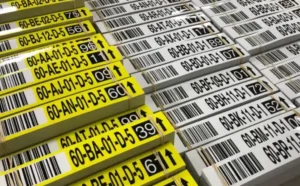
In the logistics industry, efficiency is paramount. Warehouse managers are constantly searching for ways to optimise operations, reduce errors, and enhance productivity. One strategy that has steadily gained traction, in the UK and beyond, is the use of colour-coded location labels. By simply incorporating colour into the label design, warehouses can improve both speed and accuracy in order picking, stock management, and overall workflow.
But how did this system come about, and what are the specific advantages? Let’s take a closer look at the origins and the key benefits of using colour-coded labels in a warehouse environment.

The origin of colour-coded labels
The idea of using coloured labels in warehouses can be traced back to the late 1990s. At that time, digital laser printers such as the Xerox DC12, which were capable of printing barcodes and colour simultaneously, became accessible. In fact, we were one of the first businesses in the UK to acquire one! This opened up new ways of enhancing warehouse operations.
While barcode readers rely on contrast (specifically between black and white), human eyes work differently. The cones in our eyes allow us to distinguish colour more easily than we differentiate contrast. Interestingly, studies show that humans can see black on yellow more clearly than black on white. This explains why many safety signs are designed with yellow backgrounds.
This key insight into how humans process colour became an important factor in choosing to use coloured location labels in warehouses.

Why colour recognition is efficient
One of the main advantages of using colour-coded labels is that it’s naturally easier for the human eye to see colours than numbers or letters. Picture a warehouse worker looking for a specific label that is positioned five metres up in the air. Rather than searching for a small character reference among hundreds of similar ones, they can quickly spot a blue or green label from a distance. The process becomes not only faster but also more accurate.
This colour-coded system helps workers streamline their tasks, saving time by removing the need to double-check location details. For instance, if a specific level in the warehouse corresponds to a blue label, the worker can simply match the pallet to the blue label, speeding up the storage or retrieval process without second-guessing whether they’ve selected the correct location. The less time spent verifying numbers or letters, the faster the overall operation.

Enhancing accuracy and reducing errors
Colour-coded labels act as a visual shortcut, allowing workers to identify the correct location at a glance. This visual aid reduces the likelihood of errors that might occur when manually matching numbers or letters.
In some warehouses, multiple levels can be colour-coded using just six or seven colours, which are rotated as needed for taller shelving units. For example, a worker may be instructed to place an item on the “second blue label at 15 metres”, and they can do this without needing to know the exact numerical designation.
This simplified system works just as well at ground level as it does for higher storage locations, offering a cohesive and reliable way to identify the correct spot every time.

The introduction of colour-coded labels in warehouses, starting in the late 1990s, has had a significant impact on both efficiency and accuracy by simplifying location identification. This system leverages the human ability to process colour more quickly than numbers or letters, reducing manual checks and errors.
As a result, whether used for storage, picking, or replenishment, colour-coded labelling has become a valuable tool for streamlining warehouse operations and improving productivity.